Rules
Replay the tutorialThe idea
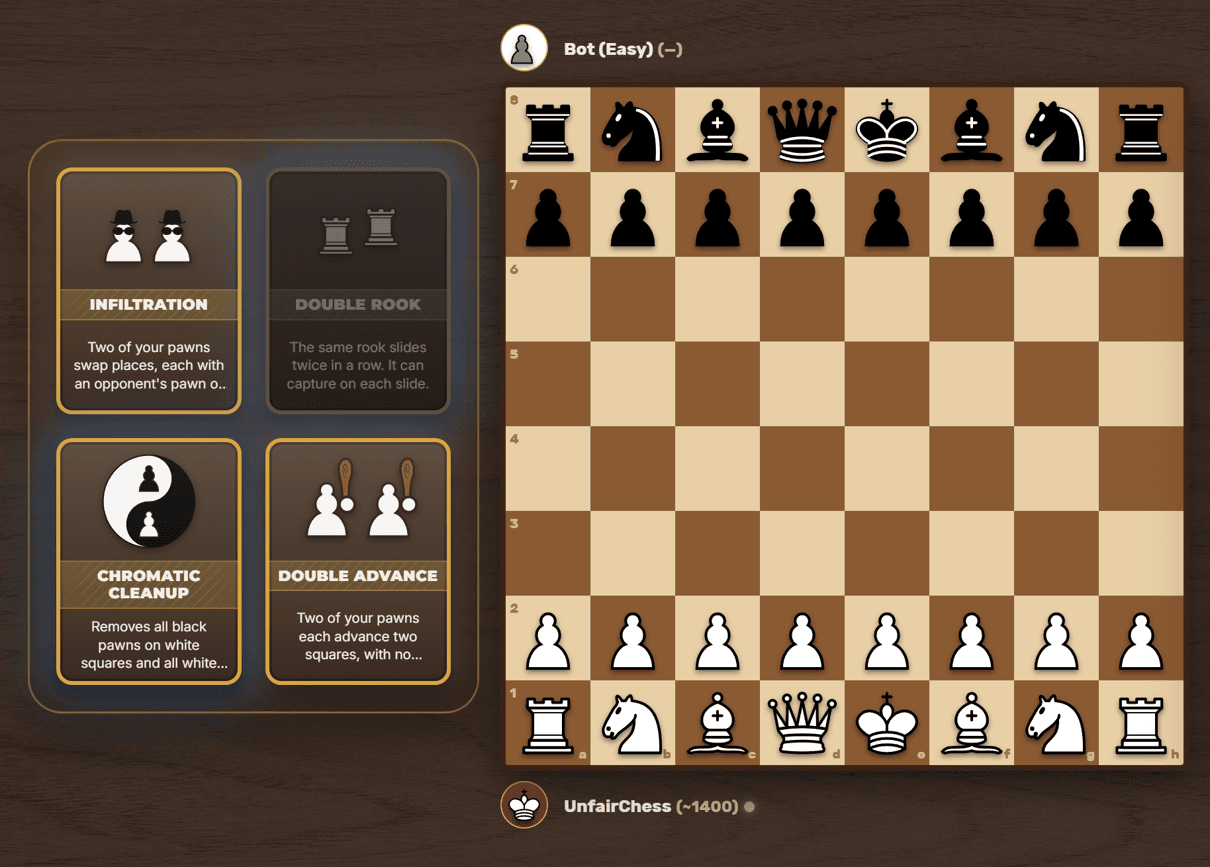
UnfairChess is regular chess: same pieces, same moves, same board. What changes is the cards. You hold four of them, and they give your pieces powers that do not exist in normal chess.
Every game is played with cards. The server is the referee: it re-checks every move and every card before accepting it, so nobody can cheat from their browser.
Chess basics
The goal is to checkmate the enemy king: threaten it with no way out. A game can also end level, which is called a draw.
The board has 64 squares. Each player starts with 16 pieces, White moves first, and then players take turns.
Every piece moves its own way.
- The king moves one square, in any direction.
- The queen goes as far as she likes, in a straight line or diagonally.
- The rook goes as far as it likes, but only in a straight line.
- The bishop goes as far as it likes, but only diagonally.
- The knight moves in an L, and it is the only piece that jumps over others.
- The pawn moves one square, or two on its very first move. It captures diagonally, never straight ahead.
Three moves break those rules.
- Castling tucks the king away: it shifts two squares towards a rook, and the rook hops to the other side. Neither piece may have moved yet.
- En passant: an enemy pawn that moves two squares and lands right beside yours can be captured as if it had only moved one. Only on the very next move.
- Promotion: a pawn that reaches the far end of the board becomes another piece, almost always a queen.
And this is how a game ends.
- Check: your king is threatened and you have to deal with it right away.
- Checkmate: your king is threatened and no move saves it. You have lost.
- Stalemate: you are not in check, but none of your moves is legal. The game is a draw.
Your hand
Each player has their own deck, shuffled at the start. Both hold exactly the same cards: only the order differs, so nobody gets a better draw.
Your hand always holds four cards. As soon as you play one, you draw again. The card you played goes to the discard pile, which both players can see, and never comes back. If the deck runs out, you finish the game with what you have left.
Cards do not all show up as often: 31 are common, 24 rare and 3 legendary. The rarer a card, the fewer copies it has in the deck. The glow behind a card tells you which one it is.
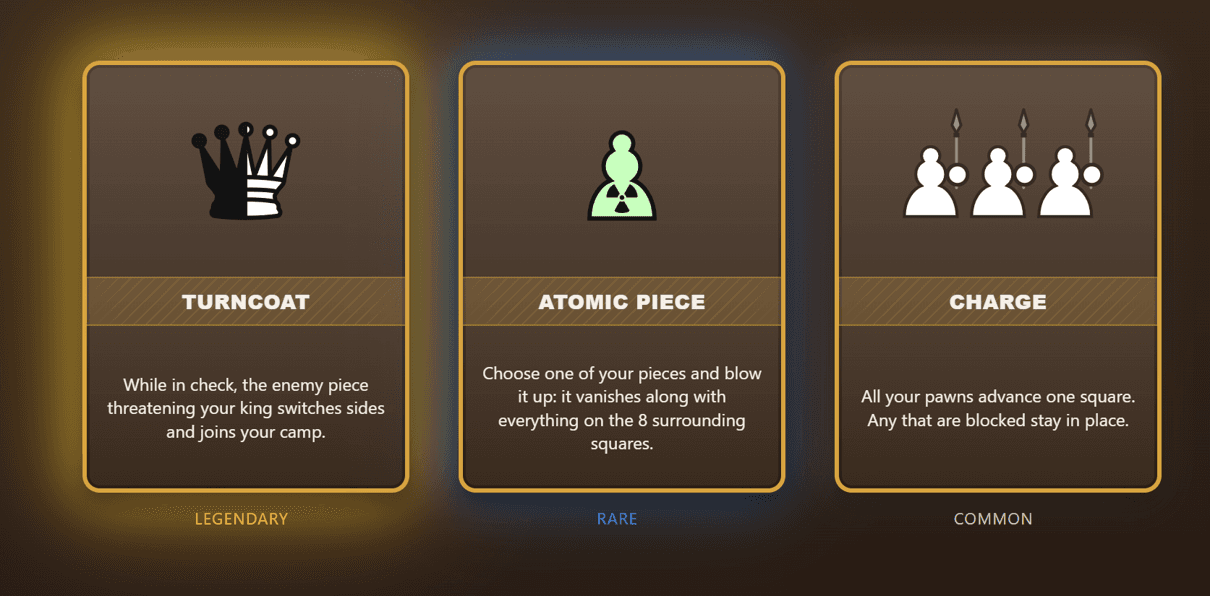
And if you really dislike your hand, one card throws all of it away and draws four new ones.
1 card:
Playing a card
One card per turn at most, and only when it is your turn. You click it, it opens up, you press Play, and the squares you can act on light up in red.
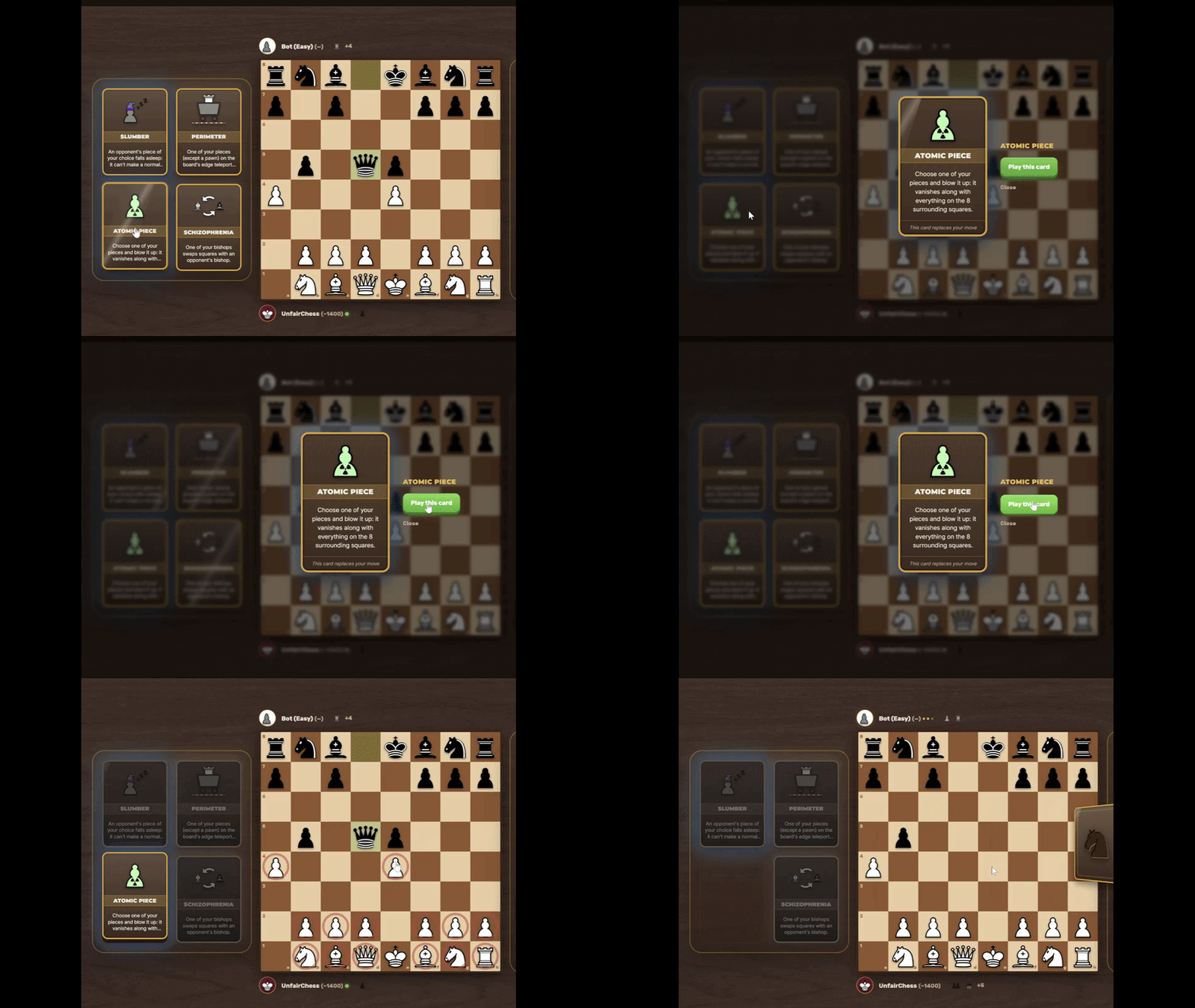
A greyed-out card cannot be played in the current position. A card that puts a captured pawn back on the board, for instance, stays grey until something of yours has been taken.
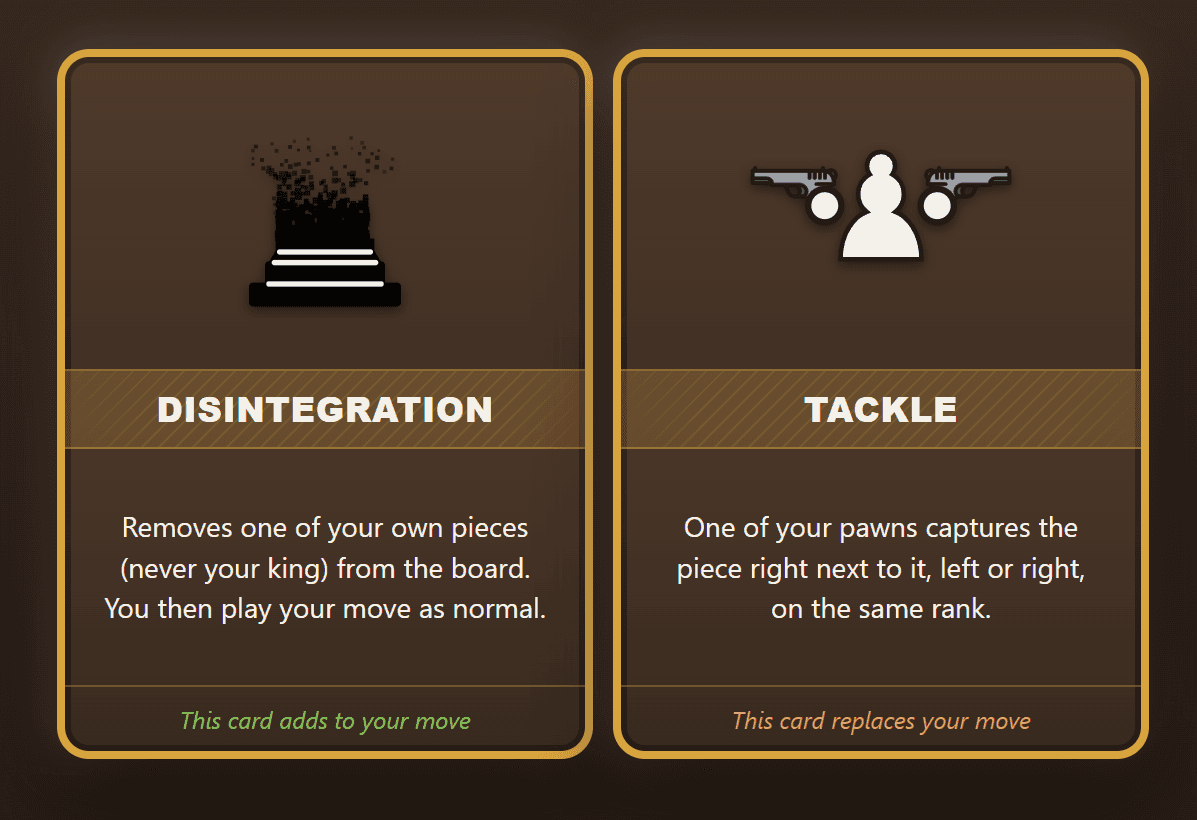
A line at the bottom of each card says what it costs.
- It replaces your move: you play it and your turn is over. That covers 47 of the 58 cards.
- It adds to your move: you play it, then you still play a normal move in the same turn. Eleven cards work that way.
One rule never changes: the king can never be destroyed or switched sides. A card may move it or block it, but you always win by checkmate.
While you are in check, only the cards that get you out of check stay playable. That holds even in checkmate: if one of your cards can still save you, the game keeps going and a message tells you so.
Card families
The 58 cards fall into seven groups. Click a name to see the card in full.
Moving differently
One of your pieces moves in a way normal chess does not allow: a pawn going three squares, a knight jumping twice in a row.
21 cards:
Swapping places
Two pieces trade squares, and nobody is captured. Sometimes two of yours, sometimes one of yours against one of your opponent's. Seven of these add to your move.
9 cards:
Destroying
Removing pieces from the board without a normal capture, sometimes several at once, sometimes your own included. Kings are always spared.
5 cards:
Bringing back or transforming
Putting a captured piece back on the board, or changing what a piece already in play is.
7 cards:
Saving yourself
Playable only while your king is threatened, and for some of them only once you are already in checkmate.
5 cards:
Reacting to the last move
They look at your opponent's last move, to undo it or make them pay for it. Unplayable if their last action was a card.
3 cards:
Getting in the way
They leave your pieces alone: they limit what your opponent can do on their turn.
3 cards:
States on the board
Four cards move nothing at all. They put a state on a piece, and that state lasts until it goes off. Both players can see it: nothing is hidden.
- Green means poisoned. If your opponent captures it, the piece that just took it dies with it. Their king always walks away.
- Grey with a ZZZ means asleep. The piece cannot move at all, until one of the two kings is put in check, and then every sleeping piece wakes up at once.
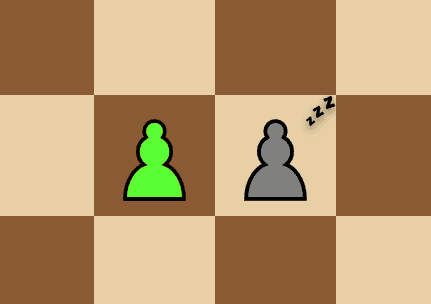
- A blue halo means shielded: your opponent cannot capture that piece on their next turn.
- A stick of dynamite means booby-trapped. If the piece takes or gets taken, it blows up along with everything on the eight surrounding squares. Kings survive.
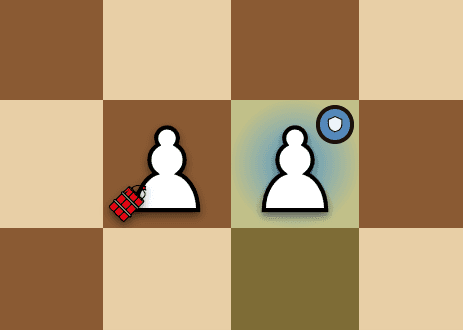
A black piece turns white while it is poisoned or asleep. That is not a bug: the tint needs a light piece to show at all. Who it belongs to is still clear from where it sits on the board.
One last thing: if any of these restrictions would leave your opponent with no legal move at all, it gives way for that one move. Otherwise games would be won by a stalemate that is not really one.
4 cards:
Ending a game
A game ends in checkmate, stalemate, a draw both players agree to, or a resignation.
If you leave a game in progress, your opponent can claim victory after thirty seconds, and you lose by forfeit after two minutes. Against the bot, your game waits for you a few minutes. Reloading the page costs nothing: you get your seat back.
After that, either player can offer a rematch, which is replayed with the colours swapped.
Coins, rating and challenges
Before starting a game you pick a stake in coins. The winner takes the loser's stake; on a draw, nothing moves.
You also pick between friendly and rated. Only rated games touch your Elo, which starts at 1400. Your first ten rated games move it much faster, to place you at the right level quickly.
You can also earn coins without playing a full game: a bonus on your first connection of the day, and three challenges renewed daily. The cards you play unlock badges on your profile, and coins buy hats for your king.
Games against the bot never count, neither for Elo nor for coins.